

Vijay Hazare Trophy 2025-26: Shubman Gill’s comeback for Punjab analysed as he looks to rediscover form after a tough ODI phase.


Shubman Gill’s much-anticipated return to competitive cricket for Punjab in the Vijay Hazare Trophy 2025–26 ended in disappointment, as India’s ODI and Test captain was dismissed for just 11 runs against Goa. The performance once again highlighted his continuing struggle with form in white-ball cricket, a concern that goes beyond one match and continues to shadow Gill’s short-format journey.
Forgettable VHT return
In Jaipur, Punjab comfortably chased down Goa’s 211, but Shubman Gill failed to make an impact at the top of the order. Chasing a manageable target, the Punjab opener never quite settled and looked short of his usual fluency.
Opening alongside Prabhsimran Singh, Gill scored 11 off 12 deliveries before being dismissed by Vasuki Koushik, mistiming an attempted stroke as he tried to break free. The brief stay summed up a scratchy innings that ended without momentum.
It was Gill’s first Vijay Hazare appearance in six years, having last featured in 2019. Returning after a break due to injury and national commitments, and with leadership duties awaiting him at the international level, Gill instead endured an outing that underlined his unresolved white-ball struggles.
Read More: Shubman Gill wants better preparation for Tests; recommends 15-day camp before every series
Prolonged white-ball lean patch
To understand why Gill’s low score in the Vijay Hazare Trophy matters, it is important to look beyond a single innings and examine the broader pattern that has emerged over the last ten months.
Between March 2025 and January 2026, Gill has failed to register a single half-century in international white-ball cricket. During this period, he featured in seven ODIs and fifteen T20Is without producing a defining knock in either format. His last white-ball fifty came more than ten months ago, a statistic that underlines the depth of his current struggle.
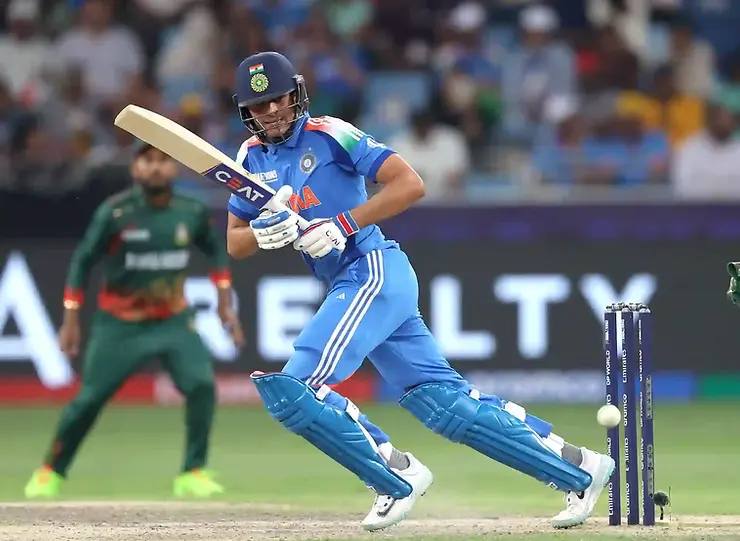
The ODI numbers are particularly concerning. In his last seven innings in the format, Gill has aggregated just 130 runs at an average of 18.6 and a strike rate of 75.1, without crossing the fifty-run mark even once. For a batter who once averaged close to 60 in ODIs and was considered India’s most reliable top-order option, the decline is significant.
His T20I returns reflect a similar trend. Recent scores of 29, 46, 15, 5 and 37 against Australia, followed by 4, 0 and 28 against South Africa, show brief flashes of promise but no sustained impact. The pattern extended to domestic cricket as well, with Gill managing only 11 runs in his return match for Punjab against Goa in the Vijay Hazare Trophy in January 2026.
This prolonged slump eventually led to Gill being left out of India’s T20 World Cup 2026 squad, a rare omission for a player of his stature and reputation within the national setup.
What makes the contrast even sharper is his performance in Test cricket during 2025. While white-ball runs dried up, Gill flourished in the longest format, finishing the year as the highest run-scorer in Tests with five centuries to his name. The disparity between his red-ball dominance and white-ball uncertainty points to technical and mental adjustments that are still missing in limited-overs cricket.
For a player once viewed as a complete all-format batter, capable of anchoring an innings or accelerating at will, this extended drought stands out. When set against earlier milestones, including becoming the fastest batter to reach 2,500 ODI runs during the 2025 England series, the current phase represents a rare and uncomfortable pause in an otherwise upward career trajectory.
Read More: Shreyas Iyer slams 82(53) on his return to competitive cricket; what’s the value he brings at no. 4?

Why does this matter for India?
Gill’s form carries weight far beyond one domestic innings. As India’s captain for the upcoming ODI series against New Zealand starting on January 11, 2026, his runs at the top are vital for both leadership authority and team confidence. The series also opens a demanding white-ball calendar, with India scheduled to play 21 ODIs across the year, making early momentum crucial.
With the ODI World Cup cycle underway, India cannot afford uncertainty from their captain in the format that shapes long-term planning. The concern is amplified by the contrast in Gill’s performances across formats.
Where things stand & what comes next?
Gill’s return against Goa will be remembered less for the runs scored and more for what it reflects, an ongoing white-ball slump that has stretched through 2025. The immediate opportunity for correction comes in home conditions when India take on New Zealand in a three-match ODI series beginning on January 11, 2026, in Vadodara, followed by matches in Rajkot on January 14 and Indore on January 18. With a packed international year ahead, these games offer Gill a crucial chance to rediscover rhythm, regain confidence and re-establish himself as India’s first-choice white-ball leader.
Read More: Bittersweet 2025: Shubman Gill at the Crossroads of Leadership and Reinvention


