
With limited domestic first-class structure, is it realistic to expect India Women to consistently succeed in Test cricket?
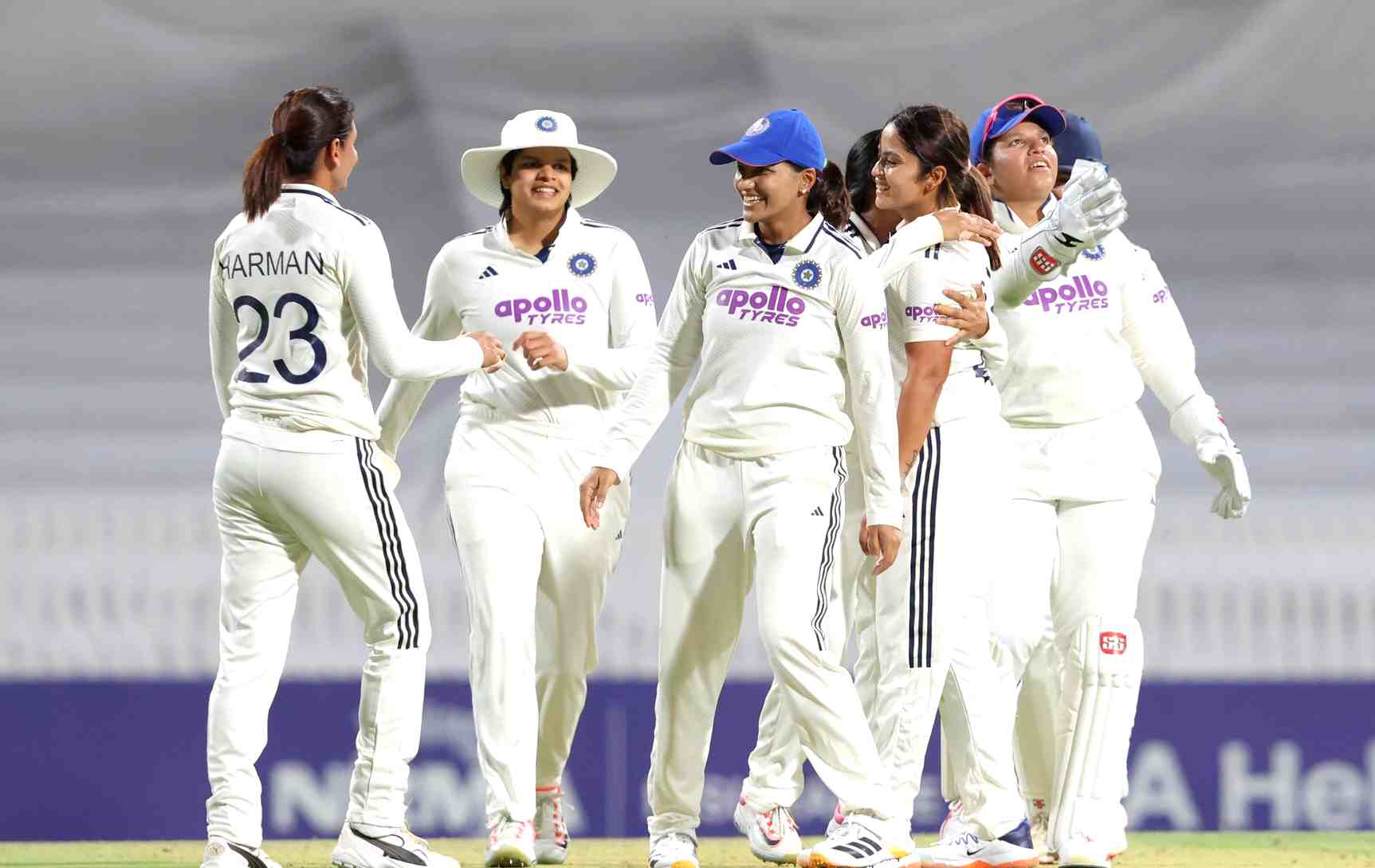
In Test cricket, few particular shots reflect a lot about a player’s approach and mindset. As such, during the third session of India women’s one-off Test against Australia at the WACA, Jemimah Rodrigues’ dismissal highlighted a lot of loopholes of the visiting side. Having played several white-ball games over the years, their limited exposure to FC cricket has heavily hampered their red-ball preparations.
Rodrigues, out of nowhere, attempted a cheeky shot against Annabel Sutherland that went horribly wrong. On 14, she moved across her stumps far too early and lost her shape while trying to scoop a back of a length delivery around the off stump. The ball ballooned in the air before wicket-keeper Beth Mooney completed a simple catch.
Justin Langer, the former Australia coach’s ‘damn and poor cricket’ feeling echoed the same emotion of Sunil Gavaskar against Rishabh Pant from the Border-Gavaskar Trophy (BGT) 2024/25. Undoubtedly, India have earned massive success in the white-ball formats recently, but they have made little progress in red-ball cricket.
India women fail to adapt to conditions and shift approach
Since the beginning of 2021, the India women’s team have played three away Tests, suffering their first defeat against Australia in Perth, while the other two matches ended in draws. On the third day of the Perth Test, they were bundled out for just 149 before the home side completed an easy chase by 10 wickets.
India failed to cross the 200-run mark twice in the game. In the last five years, they have scored more than 250 and faced 90+ overs in an innings only twice in six outings. This substantiates their poor performance in the batting department, which was also on display in Perth.
On the bouncy surface, the visiting batters failed to adapt to the conditions and shift their white-ball approach. Smriti Mandhana went for a massive drive against Lucy Hamilton. And, the ball nipped back to sneak through the gap between bat and pad to break her stumps.
Even a veteran like her went on to make the same mistake in the second innings. The left-handed batter was in two minds whether to drive or cut the ball, which was close to her stumps. It resulted in an inside edge dragging it into the stumps.
Captain Harmanpreet Kaur also experienced the same fate. She fell to a loose shot as the right-handed batter fished at a wide delivery outside the off-stump. The ODI World Cup-winning captain only managed a thick outside edge to the second slip. In the first innings, despite getting a boundary on the previous ball, Harmanpreet looked to take the attack on Darcie Brown and was dismissed due to an expensive drive.
Among their 20 wickets in Perth, only two of their batters, Rodrigues and Pratika Rawal, celebrated half-centuries. However, neither of them could convert their scores into three-figures. Meanwhile, for Australia, Ellyse Perry nailed 76 runs while Annabel Sutherland slammed 129 runs at a strike rate of over 75 in the first innings.
Read More: Gaps India Women need to fill in T20I series against Australia Women down under
Better preparation in FC cricket imminent to earn success in Tests
Since 2014, India have played only eight Test matches in women’s cricket. The last time they were involved in a series comprising more than one red-ball game was in 2006. There was a period between 2015 and 2021 when they didn’t play a single Test match before visiting England.
The BCCI has taken various steps in improving white-ball cricket for India women, but they have lacked the same structure in the multi-day matches. Between 2015 and 2018, they conducted four editions of domestic inter-zonal multi-day competitions, but the quality of those matches was not up to the mark.
The preparations for multi-day matches are very important in focusing on building stamina and technique for red-ball cricket. Once the Women’s Premier League (WPL) was introduced, India’s performance in both ODIs and T20Is got better, and the results started to follow. Recently, they lifted the ODI World Cup 2025, beating South Africa in the final.
Post the WWC 2025, the BCCI secretary, Devajit Saikia, revealed their determination to increase the number of Test matches for women and introduce more multi-day events at the domestic level. He sounded optimistic about including more red-ball fixtures while drafting the next Future Tours Programme (FTP).
“Basically, women are playing more white-ball cricket — T20Is and ODIs. About three years back, India restarted playing multi-day (Test) cricket against Australia, New Zealand, and England. When Jay Shah was BCCI secretary, he took a special initiative to promote women’s Test cricket. So, now we are playing Test matches again,” Saikia told PTI in an interview.
He also acknowledged that the domestic circuit remains heavily tilted toward the shorter formats. However, Saikia believes that the phase must now evolve.
“At the senior level, we must have more multi-day tournaments. That’s one area where we have to work. All our domestic events are mainly T20 or 50-over matches. Maybe we’ll have to introduce some tournaments similar to the Ranji Trophy for men,” the BCCI secretary said.
There is no shortage of money for the board. But the question remains, where would they want to utilise that? Do they really want the India women’s side to do well in the multi-day format, or are they happy in white-ball ICC events? Do they plan to expand the number of WPL franchises using the money, or do they aim to upgrade the domestic multi-day games in women’s cricket?
For the improvement in Women’s Tests, their basic structure needs to be stable. The top players of the international circuit will need to play more multi-day domestic games in challenging situations. Without proper preparation, no team has done well in red-ball games, and for the India women, it will remain the same.
The Harmanpreet Kaur-led side is scheduled to play their next Test against England at Lord’s on July 10. The bigger focus, however, will be on whether there is a change in result and, more importantly, a shift in approach and mindset.
Read More: Takeaways for India Women from T20I series against Sri Lanka Women

