

Anatomy of a rare Test win: Breaking down how England scripted their first Ashes Test victory in Australia in 15 years.

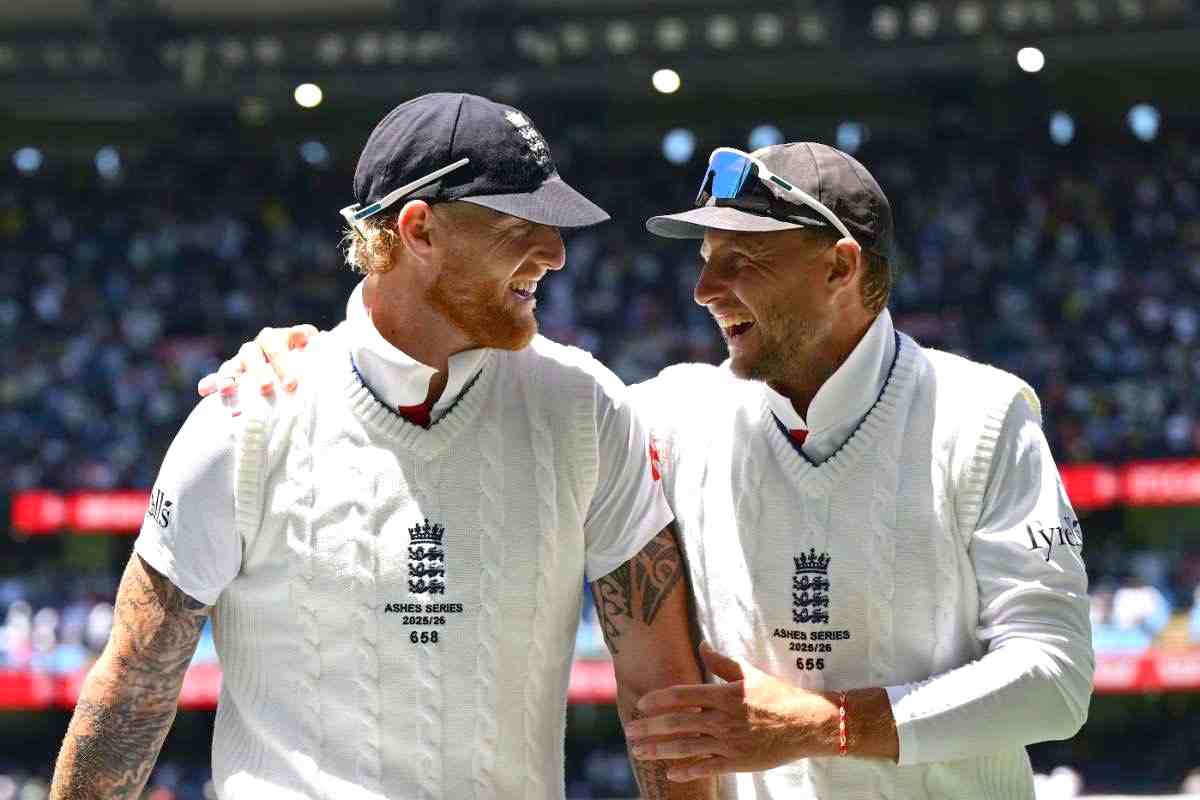
Joe Root and Ben Stokes had a long hug by the boundary rope as the winning runs of the fourth Ashes 2025-26 Test at the Melbourne Cricket Ground (MCG) came via four leg byes. The outpouring of emotion was not merely a release after a gruelling tour, compounded by the scrutiny and mental strain stemming from the drinking accusations during their Noosa holiday. It was also, unmistakably, by relief and affirmation that comes with securing a rare and hard-earned Test victory on Australian soil.
Those two veterans – Root and Stokes – had never managed a Test victory in Australia before. Their current No. 3, Jacob Bethell, was still a schoolboy the last time England tasted success Down Under. That win had come at the Sydney Cricket Ground on January 7, 2011 – 5,468 days ago. In the long, unforgiving stretch between those two moments, England endured 14 winless years across 18 Tests, a period defined by frustration and near misses.
Read More: “Need to think who exactly knows how to beat Oz,” Panesar backs Ravi Shastri as next England coach
Harry Brook’s smart batting leads under-pressure England
The emotional weight surrounding this Test went well beyond cricket. Ben Stokes had sounded mentally drained in the lead-up to the match, forced into the unenviable position of publicly defending his players following the Noosa incident, which prompted the England and Wales Cricket Board (ECB) to launch an investigation into the squad’s conduct. Opening batter Ben Duckett found himself under intense scrutiny after a video of him intoxicated went viral, while head coach Brendon McCullum faced growing uncertainty over his future, with England having effectively lost the Ashes inside 11 days.
Against the backdrop of off-field and on-field pressure, England arrived at the MCG carrying far more than just tactical plans. They were carrying history, expectation, and the burden of a tour that had threatened to spiral. What followed, however, was a performance that cut through the noise – one defined by resilience, composure, and timely brilliance when it mattered most.
A flat pitch and blazing sunshine with hard sessions in the field would have been scary for the visitors. Moreover, they were without their best bowler of the trip, Jofra Archer, who had been ruled out of the series. That was when they accepted the seam for a low-scoring thriller with both hands. Afterall, their Bazball approach suits this situation.
After bundling out Australia for 152 inside the first two sessions of the contest, England found themselves 8-3 in the fifth over. Harry Brook, under pressure of selling his side down the river on several occasions in this series, strolled into the crease at number five. He charged down to Mitchell Starc on the very first delivery. Soon, with the departure of Root, they crawled at 16-4.
That was when Brook played a confusing yet smart knock of 41 runs. That turned out to be the second-highest individual score of the entire Test. His 34-ball innings was decorated with two fours and two sixes, but made a massive impact in England’s entire innings of 110 runs.
In front of a record-breaking crowd of over 94000 on the opening day, the Yorkshire batter flipped Michael Neser across the line for a boundary. When the Queensland bowler dragged the length back, Brook swivelled across on the front foot to hammer the pull over the wide mid-on for a six.
Read More: Pat Cummins, a rare successful bowler captain: His achievements & underlying mantra

England’s opening stand gives them solid platform in 175-run chase
In a chase of 175 on a surface where 30 wickets had already fallen in the first 109.4 overs, England needed a decent start. And that’s where Duckett (34) and Zak Crawley’s (37) opening stand of 51 runs gave them the platform. They realised the importance of two factors- firstly, the ease of scoring against the hard ball, and secondly, when the effect of the roller was fresh.
For this fixture, England finally decided to move on from their struggling number three, Ollie Pope, who made 125 runs at an average of 20.83 in this series. In the second innings, Bethell played a mature knock of 40 runs in 46 balls at number four.
On the very first ball after the second day’s Tea break, the Southpaw reverse paddled Scott Boland for a couple of runs. That was a smart plan, which saw Steve Smith pushing the fielders on the edge of the boundary. Bethell, apart from a few big shots, mostly looked to tick the scoreboard with singles and doubles from that point.
Read More: Bazball or plain schoolboyish cricket – Why England fell flat in Ashes 2025-26?
Brydon Carse and Josh Tongue justify Ben Stokes’ faith
On this surface, Australia missed both Pat Cummins and Josh Hazlewood, who could consistently bowl fuller and straighter at the batter. That was exactly what Brydon Carse and Josh Tongue did well across the two innings.
Carse finally justified Stokes’ faith with 4-34 in the second innings. His dismissal of Travis Head sparked a collapse of 7-50 as the hosts lurched from 82-3 to 132 all out.
Tongue’s unusual action and wide of crease planning were exceptional. His release point above the perpendicular arms shocked Australia again as batters kept getting edges on attempting the flashing drives. He ended with a terrific match figure of 7-99, including his first innings’ heroics of 5-45.
They needed discipline, especially in the absence of Gus Atkinson in the second innings, who went off the field with a hamstring injury. Stokes’ plan for Alex Carey in the first innings of keeping a leg slip was on target. For the entire game, England were switched on in terms of their intent and methods.
The pitch was not balanced at all for an international Test match. Only two of the 450 men’s Test matches down under before this Ashes had ended in two days. The first one was against West Indies in 1931, and the second one was in Brisbane against South Africa three years ago. Australia batted only 479 balls in this Melbourne Test, which was their fewest in a red-ball match since the 1928 Ashes in Brisbane.
There was a warm ovation for the late Shane Warne at 3:50 PM on both days, a moment of reverence amid the drama. The quality of the contest may not have met his lofty standards, but England will scarcely mind. The win finally lifts a long-standing psychological burden, and heading into the New Year’s Test in Sydney, a possible 3-2 outcome feels far more palatable than a 4-1 defeat – weather permitting, with rain looming over January 4.
Read More: Has Bazball been counter-productive for England when they have been ahead in the game?


