

West Indies rescue a draw against New Zealand in Christchurch, scoring the second-highest fourth-innings total recorded in Tests.

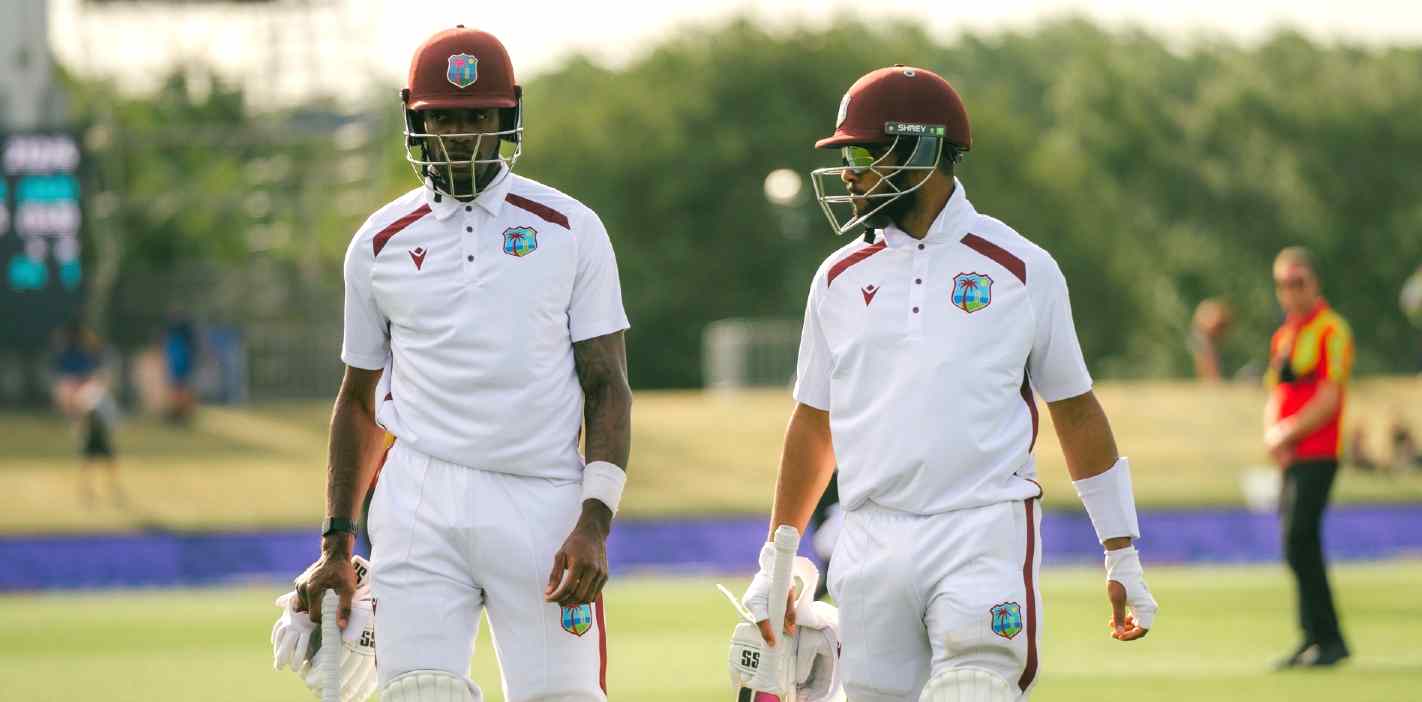
In a performance that defied logic, pressure and history itself, the West Indies produced one of the greatest fourth-innings rearguards Test cricket has ever seen, pulling off an extraordinary draw against New Zealand in the first Test at Christchurch, a match that seemed long lost after their struggles across the first three innings.
It was a game in which the West Indies were outplayed for long stretches. Their batting failed in the first innings. Their bowling lacked bite in both New Zealand efforts. By the time the hosts piled up 530 and set a near-impossible fourth-innings target of 531, the narrative looked sealed for the Black Caps. But cricket, as it so often does, wrote a different, more magical ending.
Read More: West Indies batting plummeting to new depths; What’s ailing them – A numerical & technical analysis
The magical show by the West Indies
What followed after 163.3 overs was a blockathon of defiance, endurance and redemption. The West Indies, who had slipped further after losing early wickets again in the fourth innings, rallied with a breathtaking act of resistance to finish on 457/6, the second-highest team total ever made in the fourth innings of a Test match. Only England’s 654 for 5 in the timeless Test of 1939 stands higher.
At the heart of this miracle was Justin Greaves, who batted as though the game operated on his personal clock. His career-best unbeaten 202 made him only the seventh player in Test history, and the first visiting batter in New Zealand, to score a double-hundred in the fourth innings of a match. Facing 388 balls, the most ever by a West Indies batter in the last innings of a Test, Greaves transformed the impossible into belief, with his one defensive stroke at a time.
Shai Hope joined him with a gritty 140 and formed a superb 196-run partnership that dragged the Windies back into the contest after their early stumbles. It was a reminder that this was the same West Indies side that recently defeated Australia; it is the same team that has been criticised, doubted and written off, yet continues to reveal flashes of its rich, fighting heritage.
With Hope gone, New Zealand spotted a final chance to break through. Yet the moments that followed produced the most unforeseen and touching twist of the contest.
Read More: Test Cricket on an infinite downward loop in the Caribbean: Is there a solution in sight?


Kemar Roach’s dominance
Known for his ferocity with the ball, the 37-year-old Kemar Roach produced a batting performance that stunned the cricketing world. His 58 not out was the best of the 86 Tests in his career and took 233 balls and 282 minutes to construct. Roach became the first No. 8 or lower batter in Test history to face more than 200 balls in the fourth innings.
His 180-run* stand with Greaves for the seventh wicket, consuming 409 deliveries, is now the highest partnership for the seventh wicket or lower in the fourth innings of a Test match. Even more remarkably, it was only the third time in Test history that two 150-plus partnerships occurred in the final innings and the first such instance since 1979.
New Zealand tried everything. Off-spinner Michael Bracewell bowled an exhausting 55 overs, while pace bowler Jacob Duffy ended the match with eight wickets from 60.4 overs, 43 of those in the second innings alone. The Kiwis reviewed desperately and ran out of reviews. Fate even stepped in on Roach’s side when he was given not out on a caught-behind call in the 143rd over, despite replays showing a faint edge. With no reviews left, New Zealand could only watch and be helpless as history unfolded.
Roach’s heroics did not end there. His 5/78 in New Zealand’s second innings also made him the fourth-oldest player in Test history to combine a five-wicket haul with a half-century in the same match.
Ultimately, the West Indies fell 74 runs short of surpassing their own benchmark for the highest successful fourth-innings chase – the iconic 418 against Australia in 2003. Yet, the day was about far more than numbers. It was about the character they displayed: a team criticised for inconsistency and underperformance now showing a resilience that suggests a far brighter future.
From time to time, the West Indies show us what they could achieve in test cricket. If only they could be a bit more consistent.
— Harsha Bhogle (@bhogleharsha) December 6, 2025
Read More: Australia pacers wreaked havoc on West Indies in Kingston: Why they are the best in the business


